
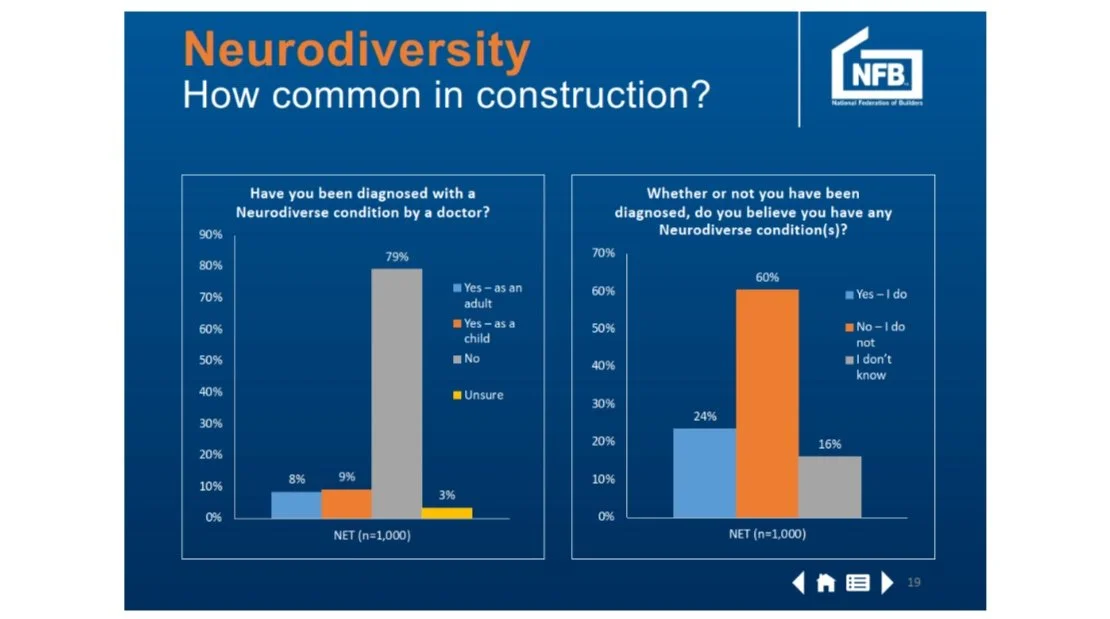
The built environment sector has been making significant progress in raising awareness and understanding the benefits of diversity and inclusion, but how do we move beyond intent and slogans to measurable change?
Cognitively diverse teams enhance innovation, retention, and resilience in ways that resonate with architects, engineers and others across the sector – so how can we embrace neuroinclusion and increase levels of psychological safety in our workplaces?
Neuroinclusive design principles—clarity, predictability, sensory balance, and refuge spaces—also support safe, usable environments for women and other underrepresented groups. Lighting, sightlines, acoustics, layout, and wayfinding shape whether people can navigate and participate effectively.
Do we need to measure inclusion and safety to the same
extent we measure carbon and cost?
Can we elevate neuroinclusion from aspiration to established practice, embedding it within professional norms?
Can we move from narrative-driven DEI to evidence-driven inclusion science, focusing on the practical frameworks, diagnostics, and metrics to achieve measurable change?
This debate, in the wake of Neurodiversity Celebration / Awareness Week, asks how neurodiverse thinking can be recognised not as an adjustment, but as a catalyst for innovation and better outcomes.
Chair: Stephen Gill, Consultant & founder of Engineering Differently
Speakers:
Professor Tadj Oreszczyn, Professor of Energy and Environment & Director UCL Energy Institute, University College London
Naomi Glover, Neuro-informed Ltd & Kings Entrepreneurship Institute
Peter Anderson, Chair - Troup Bywaters + Anders LLP
Daisy March, EDI Manager, Institution of Engineering and Technology
Martin Griffiths – Principal Geotechnical Engineer, GHD
Venue: CIBSE, 91-94 Saffron Hill, London EC1N 8QP
Date: 26th March 2026
Downloads:
ED192 - Neurodiversity - Invitation
Neurodivergence in the construction industry - NFB
Opening up building services to neurodiverse engineers, CIBSE Journal, Jan 2022
Design for the Mind. Neurodiversity & the Built Environment - PAS 6463, BSI
Neurodiversity - selected references
Extended reading list:
Cultural Reframing & Neurodiversity
NeuroTribes – Steve Silberman
Reframes neurodivergence as difference rather than deficit.
Divergent Mind – Jenara Nerenberg
Explores gendered and intersectional dimensions of neurodivergence.
Cognitive Diversity & Innovation
The Neurodiversity Edge – Maureen Dunne
Links neurodivergent cognition to competitive advantage.
Rebel Ideas – Matthew Syed
Examines collective intelligence and cognitive diversity in complex systems.
Psychological Safety
The Fearless Organisation – Amy Edmondson
Definitive research on psychological safety and high-performance teams.
Inclusive & Neuroinclusive Design
Mismatch – Kat Holmes
Frames exclusion as design mismatch rather than user deficit.
Inclusive Design for a Digital World – Regine Gilbert
Principles of clarity and sensory balance applicable to spatial design.
Building for Everyone – Annie Jean-Baptiste
Embedding inclusion within systems and products.
Environmental Psychology – Robert Gifford
Evidence on how environments shape cognition and behaviour.
Measuring Inclusion & Governance
Measuring Inclusion – Paolo Gaudiano
Argues inclusion should be measured with the same rigour as financial and carbon metrics.
The Inclusion Solution – Paolo Gaudiano
Systemic integration of inclusion into organisational practice.
The Tyranny of Metrics – Jerry Z. Muller
A caution against poorly designed metrics that distort behaviour.
Conscious Leadership & Behavioural Foundations
Conscious Inclusion – Catherine Garrod
Measurement frameworks are necessary — but they are not self-executing. Inclusion ultimately succeeds or fails at the behavioural level.